Questions targeted
The questions the change answers, measured before and after it.

GEO Monitoring
Track over time how ChatGPT, Gemini, Perplexity and Claude answer your customers’ questions: whether they name you, recommend you, cite your site and which competitor they choose instead of you. Copilot is added on request, observed through its interface.
The third question
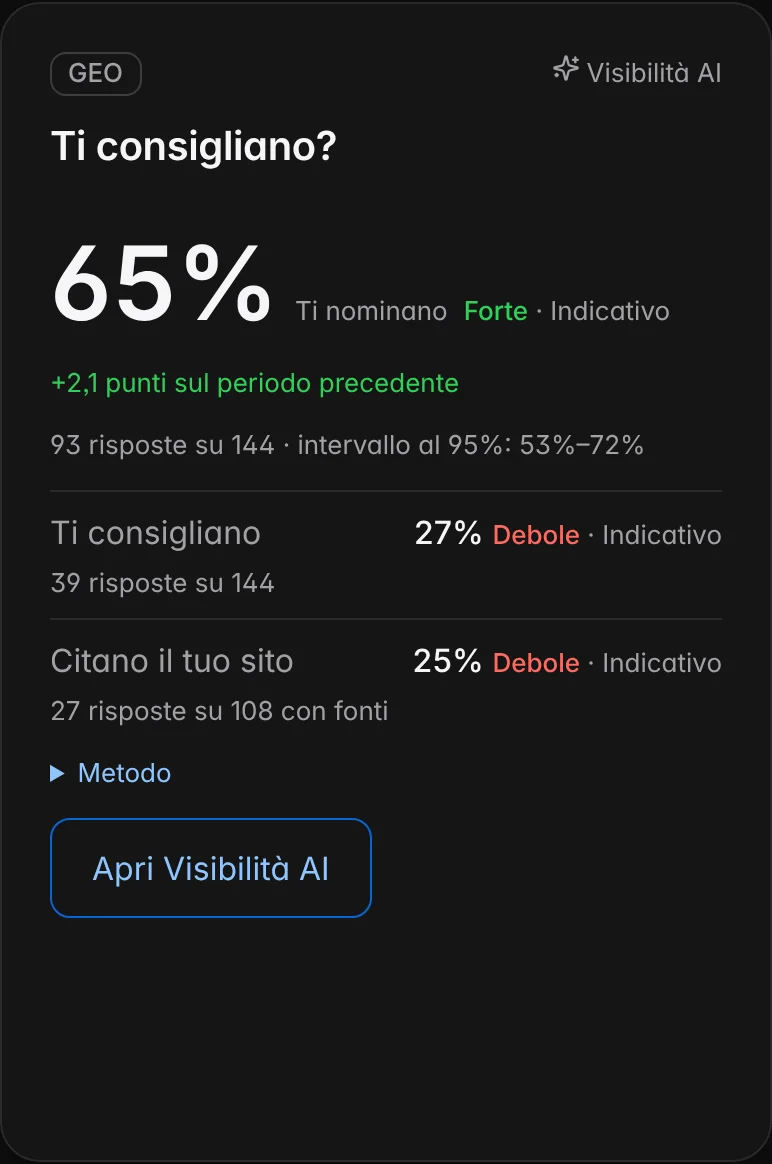
GEO, Generative Engine Optimization, asks whether AI assistants recommend you. Being named is the first step; being pointed out to someone who has to choose is the second; seeing your website among the answer’s sources is the third.
Three steps up: the answer names the brand, recommends it, cites one of its pages. Each step is counted on a different base, which stays declared.
The answer contains your brand, in any position and with any tone.
Base: the valid answers of the observation
The answer points your product out to someone choosing between several brands.
Base: the answers that recommend someone
A page from your official domain appears among the answer’s sources.
Base: the answers that show their sources
Collection after collection
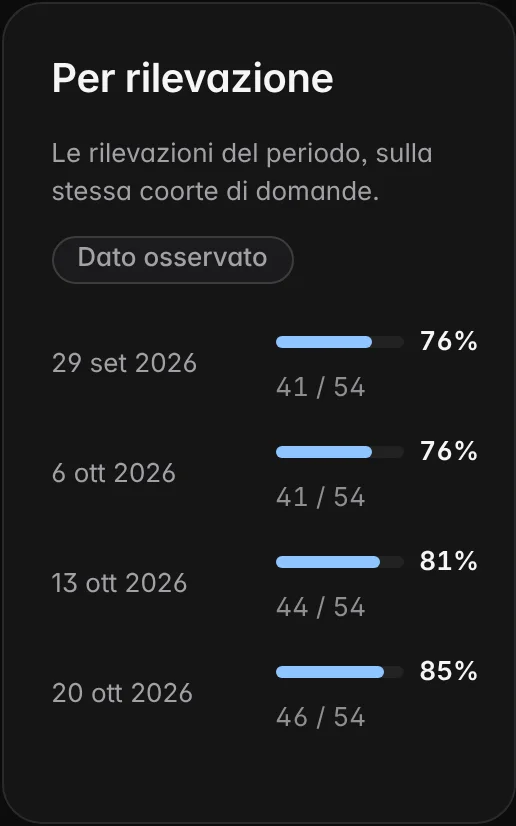
The same questions, put to the same assistants under the same conditions, repeated over time. A change is read on the same cohort of questions, with its base, and does not come from a different sample.
Preferred competitors
For each intent you see which competitor is recommended in your place and with which recurring phrases and sources. It is a reading of the answers, not of the model: it says what the answer uses, not what it thinks.

A sample answer about fictional brands: the competitor is recommended thanks to an independent guide, your brand is only named, and a doubt arises from a fact the website does not state.
QuestionWhich earbuds should I choose for running in the rain?
AI assistant · sample answer about fictional brands
For running, a light, water-resistant model is best. The Orbit Run are the most suitable choice because a runners’ guide tested them in the rain. The Northstar Pulse are also an option, but it is not clear how water-resistant they are.
The competitor is recommended: the GEO lens counts it as a preference.
The support is an independent guide that names only the competitor.
Your brand is named but not recommended: the first step, not the second.
The doubt comes from a fact your website does not state in text.
Independent sources
Magazines, reviews and forums make their way into assistants’ answers. For every source cited you see what it is, whether it names you and in what tone: this is where the GEO lens meets the question of trust.
Four sample sources cited by assistants on one intent of a fictional brand: what they are, whether they name the brand and in what tone.
| Source | What it is | Names you? | Tone towards you |
|---|---|---|---|
| Trade magazine | A field test comparing six models. | No, it cites only the competitor | None, because it does not name you |
| Review site | The opinions of people who bought, with the average rating. | Yes, in the product reviews | Positive on comfort, mixed on battery life |
| Enthusiasts’ forum | A discussion about which models to use when travelling. | Yes, in two posts out of ten | Neutral: it describes without judging |
| Your site | The product page with the technical specifications. | Yes, it is your page | Not assessed: it is your own voice |
A lens, not a score
The GEO lens shows its indicators, each with its own base. The AI Trust Score is still calculated as it is, on six dimensions with published weights: visibility and recommendations are two of them, and the lens never becomes a second score.
The same four issues read twice: with the GEO lens, which shows separate rates, and with the AI Trust Score, which sums up six dimensions in one value with an interval.
| GEO lens | AI Trust Score | |
|---|---|---|
| What it shows | Three separate rates: named, recommended, cited. | A value from 0 to 100 with interval and coverage. |
| How to read it | Each rate with its own base, by intent and assistant. | Six dimensions weighted by a published method. |
| What it looks at | Assistants’ answers, alongside the other three lenses. | Only AI assistants’ answers to your panel. |
| When it is useful | To understand where and why a competitor is preferred. | To follow over time how assistants present the brand. |
Measuring a change
After a change you read the same questions again and compare them with questions the change does not touch. If both shift, the cause lies elsewhere; if only the first do, the effect is more credible, without being promised in advance.
The questions the change answers, measured before and after it.
Similar questions the change does not touch, measured on the same days.
The change in the first minus the change in the second, with its interval.
Frequently asked questions
Which assistants GEO monitoring is based on, how often it repeats, how it differs from AI Visibility and why nobody can guarantee a recommendation.
AI visibility is the view where you read answers, mentions and sources question by question. GEO Monitoring uses it as a lens: it follows the three steps over time, by intent, and shows which competitor is preferred.
ChatGPT, Gemini, Perplexity and Claude, depending on the plan and the qualified models; Copilot on request, observed through its interface as a user sees it. Every answer records assistant, model, language, market and collection date.
At the frequency you choose for the panel, confirming the cost before each collection. Two observations are compared only on the same cohort of questions.
No one can dictate what an assistant recommends. You can make the information the answers use clear and verifiable, and measure whether anything changes.
Related paths
Each feature answers a specific question. From here you move on to related features, to the methodology behind their measures and to help for using them in everyday work.
See which customer questions bring you up on Google and Bing, which pages earn clicks and who ranks ahead of you, intent by intent.
ReadAI Overviews, AI Mode, featured snippets and related questions: see whether Google’s direct answers use your website and what is missing.
ReadCollect your brand mentions with date, channel, topic and tone, exclude namesakes and always trace back to the original source.
ReadWhat to change, on which page or source, with what text and in what order: the GEO action plan, checked on the same questions.
Read