
SEO Intelligence

Do they find you when they search?

See which customer questions bring your website up on Google and Bing, which pages earn clicks and where a competitor ranks ahead of you. It is the first of the four questions: before they can recommend you, they have to find you.

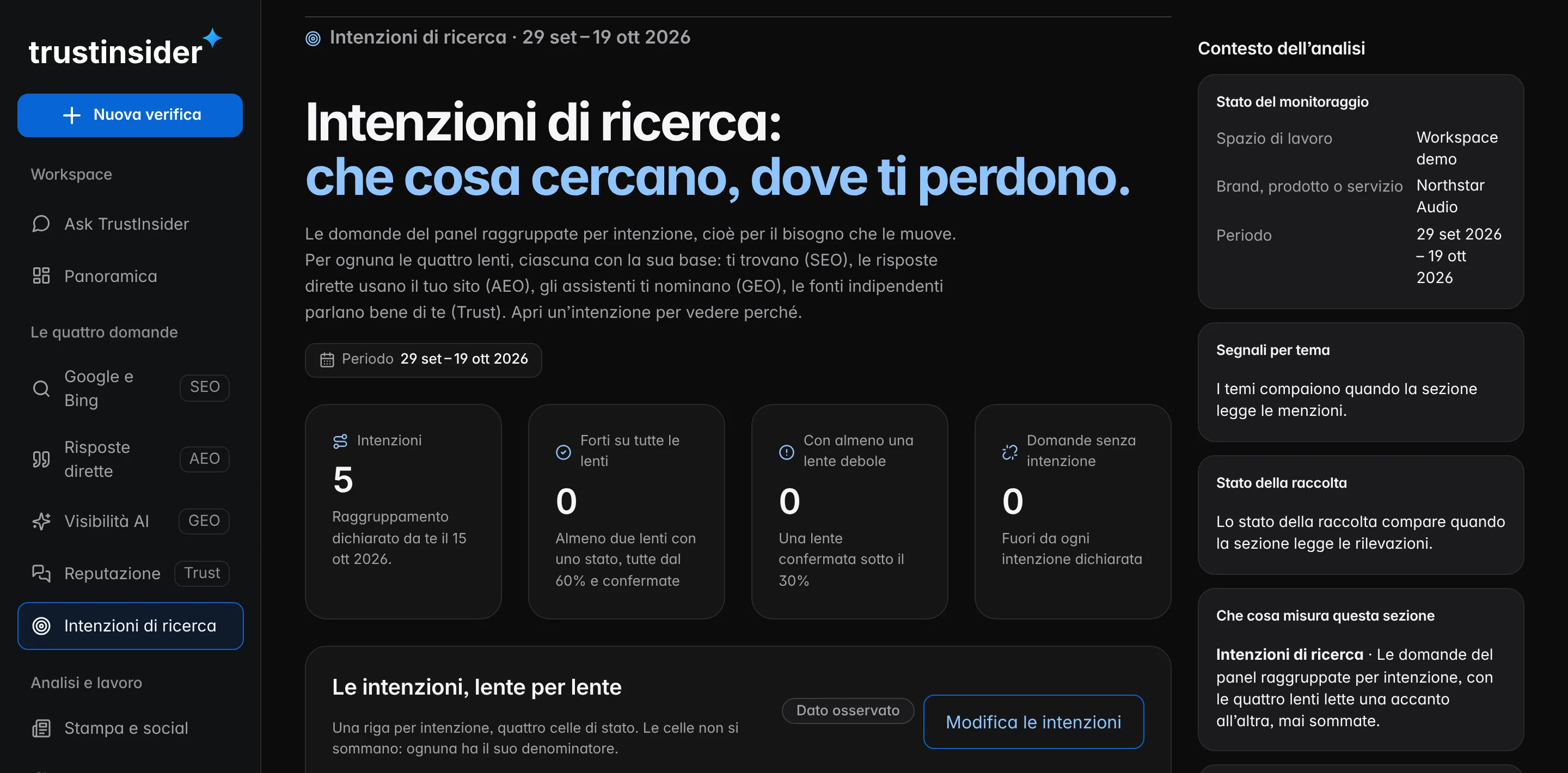
The Search intents view: panel questions grouped by need, with the four lenses and their base.
Demo data · Northstar Audio

The first question

Before recommending you, they have to find you.

AI summaries and assistants often draw on pages that search engines have already indexed and show. A page that no search brings to the surface rarely becomes a source: that is why the four questions start from organic search.

A smiling woman on a yellow sofa in a bright flat compares travel headphones on her laptop next to an open suitcase. AI-generated scene.
AI-generated image · Illustrative scene
The four questions, each with its own sources and base

One row per lens: what is observed to answer the question and what base it is counted on. The four measures stay separate and do not form an index.

QuestionWhat is observedOn what base
SEO · Do they find you?Rankings on Google and Bing, clicks and impressions from the connected property.The searches observed and the property’s period.
AEO · Do they use your information?AI summaries, snippets and related questions that answer before the links.The panel questions that show a direct answer.
GEO · Do they recommend you?Mentions, recommendations and citations in AI assistant answers.The valid answers of each observation.
Trust · Do they trust you?The tone of reviews, articles and conversations relevant to the brand.The relevant mentions collected from active sources.

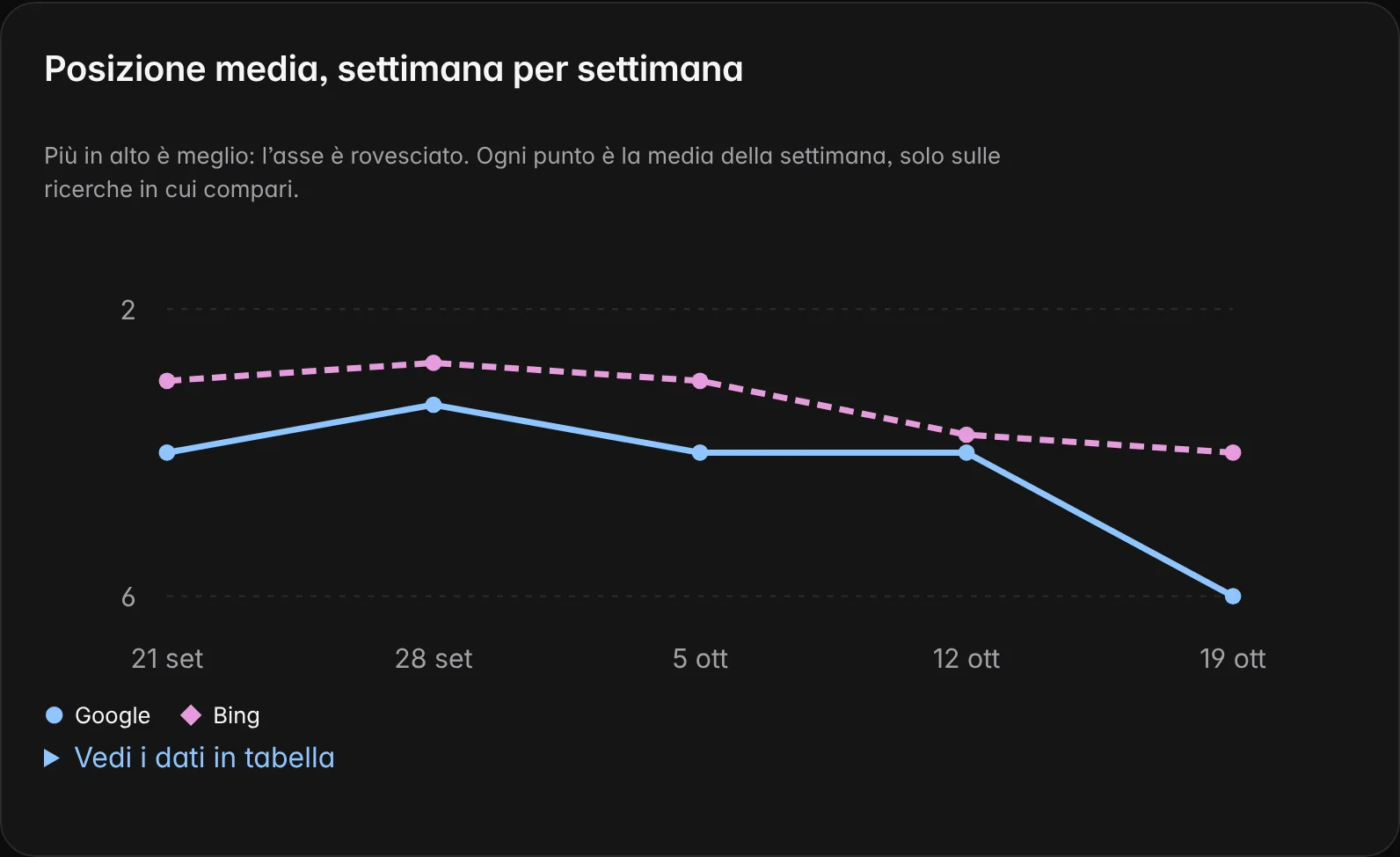
Rankings over time

Google and Bing, one line per engine.

Follow your website’s average ranking week by week, separately for each engine. Each point counts only the searches you appear in: a search you dropped out of does not lower the average, it is counted separately.

Northstar Audio’s “Average position, week by week” chart: a solid line for Google and a dashed one for Bing, from 21 September to 19 October, with the axis reversed because higher is better.
Demo data · Northstar Audio

Search intents

Questions grouped by need.

Someone searching “headphones for flying” and someone asking which headphones to take on a long flight have the same need. Panel questions are grouped by intent, and for each one you read the four lenses, each with its own base.

Each question belongs to a single intent. A lens is strong, partial or weak according to declared thresholds; the four cells are never added up, so a high value in one does not make up for a low value in another.

Three intents of a fictional brand, lens by lens

Three sample intents for a fictional brand: for each, the status of the four lenses, strong, partial or weak, with the reason in a few words. The cells are not added up.

IntentSEOAEOGEOTrust
Choosing headphones for travelPartial: first page for half the questionsWeak: direct answers cite othersPartial: named, rarely recommendedStrong: positive reviews on comfort
Earbuds for runningWeak: no questions on the first pageWeak: no answer cites the websiteWeak: named in few answersPartial: mixed tone on fit
Finding out whether the brand is reliableStrong: the website is on the first pageStrong: answers drawn from the company pageStrong: named almost every timeStrong: mostly positive tone

Your site

Real clicks, from the property you connect.

With Search Console and Bing Webmaster Tools connected read-only, you see clicks, impressions and rankings for your pages. Your website’s queries can become panel questions: real search suggests what to ask the assistants.

From the connected property to the panel questions

Four steps: you connect the property, choose a country and a period, bring a query into the question panel and compare the two measures without adding them up.

  1. Connect the property

    You authorise Search Console or Bing Webmaster Tools read-only, and can revoke it whenever you like.

  2. Choose country and period

    You read the queries returned by the source, with clicks, impressions and ranking.

  3. Bring in the query

    A search that brings clicks becomes a question to ask AI assistants.

  4. Compare the two measures

    Ranking in the results and the assistants’ answer to the same question, never added together.

Who ranks ahead of you

The top ten results, name by name.

For every panel question you see who holds the first page: competitors, magazines, shops and forums. Knowing who is ahead of you tells you which source to win over, as well as which page of your website to rewrite.

The first page of a travel search, read position by position

The first six sample results for a search about a fictional brand: ahead of the product page are a magazine, a competitor, a review site, a shop and a forum.

PageSample document

Google · “noise-cancelling headphones for travel” · example

Position 1
A trade magazine with an in-flight test
Position 2
Orbit Audio, travel headphones product page
Position 3
A review site with this year’s ranking
Position 4
An electronics shop, category page
Position 5
An enthusiasts’ forum on long flights
Position 6
Northstar Audio, Aurae 2 product page
Example with fictional brands: the product page is sixth, behind four sources that are not competitors.

Reading the ranking

An average without a base says nothing.

An average ranking can improve simply because you dropped out of the difficult searches. That is why every value carries the number of searches behind it, and Google and Bing stay two measures.

Four hasty readings of search, and how to correct them

The same four observations about search read twice: hastily, without the base, and with the number of searches and the engine behind them.

Hasty readingReading with the base
Average positionIt moves from six to four: it looks like clear progress.It improves because two difficult searches dropped out of the average.
First pageThe website is there, so the search is sorted.It is there in sixteen searches out of twenty-four: eight remain open.
ImpressionsMore impressions mean more interest in the product.They also grow when the results page changes.
EnginesGoogle and Bing end up in a single value.Each engine has its own line and its own searches.

From search to work

From the ranking to the page to improve.

When a question stays off the first page, the Action Center suggests what to change: the page that should answer, the missing content, the source to reach. Then you read the same searches again.

The right page

You identify which page of the website should answer that question.

The missing content

The question and the page text are compared, sentence by sentence.

The same measure

After the change, the same searches are read again, alongside control questions.

Frequently asked questions

Questions about SEO and search intent.

What SEO Intelligence adds to the Google and Bing view, how it works with Bing Webmaster Tools, how a search intent is formed and whether it enters the AI Trust Score.

What does SEO Intelligence add to the Google and Bing view?

It groups panel questions by intent and places the other three lenses beside each one. The Google and Bing view remains the place where you read results, AI summaries and website data search by search.

Does it also work with Bing Webmaster Tools?

Yes. The connection is read-only, like the Search Console one, and Bing data stays separate from Google data: two properties, two measures.

How is a search intent formed?

By grouping panel questions according to the need they express. Each question sits in a single intent, so none is counted twice and the four lenses are read on the same questions.

Do intents feed into the AI Trust Score?

No. The AI Trust Score is still calculated on AI assistant answers, with its six dimensions. Intents are a way of reading the questions, and the lenses never become a second score.

Related paths

Each feature answers a specific question. From here you move on to related features, to the methodology behind their measures and to help for using them in everyday work.

SEO Intelligence for customer questions | TrustInsider