
Direct answers (AEO)

An answer before the links. Is it yours?

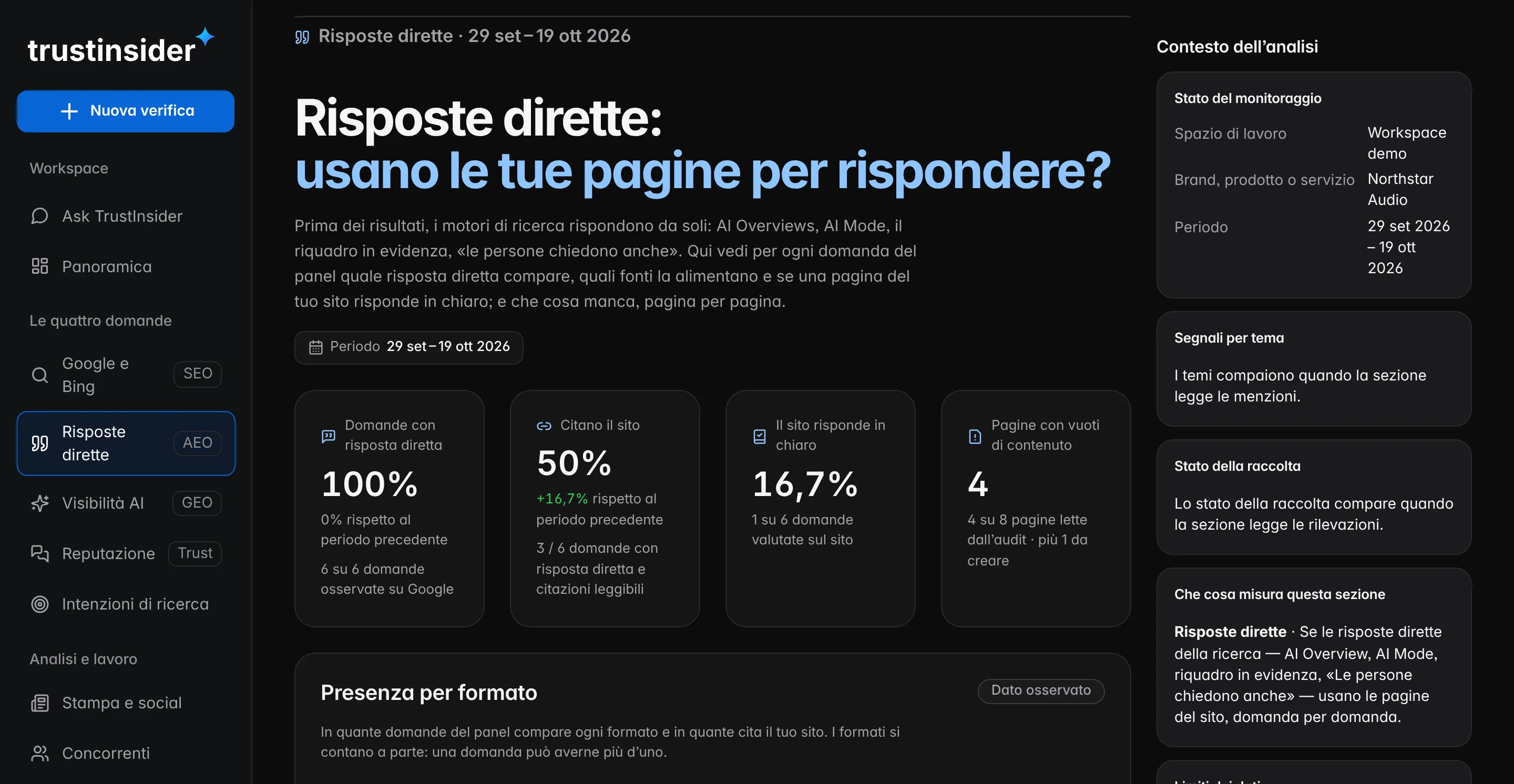
Above the results, Google answers on its own: AI summaries, featured snippets, related questions. See which direct answers appear for your customers’ questions, which sources feed them and which of your pages do not yet answer clearly.

The Direct answers view: for the panel questions, presence in AI summaries, the featured snippet and “People also ask”, and how many cite the site.
Demo data · Northstar Audio

The second question

The engine answers before the results.

AEO, Answer Engine Optimization, asks whether search engines’ direct answers use your information. It is not a ranking: it is a passage from your website that is reused, cited or ignored in the answer the customer reads first.

The four direct-answer formats observed on Google

For each direct-answer format: where it appears on the results page and what TrustInsider records to tell whether it uses your information.

FormatWhere it appearsWhat we record
AI OverviewsAt the top of the results, as a generated summary with its sources.Whether it appears, whether it names the brand and which pages it cites.
AI ModeIn a dedicated tab, as a conversation with links to the sources.The answer’s sources, observed as a user sees it.
Featured snippetAbove the first result, with a passage taken from a page.Which page supplies the passage and whether it is yours.
People also askAmong the results, as a list of related questions that expand.The questions shown and the website that answers each one.

Format by format

Four formats, counted one by one.

For every panel question we record which formats appear and how many cite your website. A question can show more than one, so each format has its own count and its own base: no total merges them.

How often a format appears and how often it cites your website

A qualitative map with no numbers: how often a direct-answer format appears for your questions and how often it cites your website, with a reading of each situation.

How often it cites your website

How often the format appears

  1. Appears often, cites you

    The format already uses your pages: protect the content that feeds it.

  2. Appears often, cites others

    The answer is there but leans on magazines or competitors: this is the priority.

  3. Appears rarely, cites you

    Few opportunities, already taken: there is little ground to gain.

  4. Appears rarely, cites others

    Before acting, ask yourself whether the question really calls for a short answer.

Question by question

Who feeds the answer the customer reads.

Open a question and see the direct answer with its sources: the magazine, the forum, the competitor’s page. When your page is missing, you know which text the engine preferred to yours.

A smiling traveller in a bright airport terminal reads a short answer on her smartphone while holding colourful headphones. AI-generated scene.
AI-generated image · Illustrative scene
A featured snippet that answers with someone else’s page

A sample featured snippet about a fictional brand: the fact is correct, but the source is a magazine, because the product page does not state it in text.

QuestionCan the Aurae 2 headphones be used on a plane with the cable?

Sample featured snippet · fictional brand

Yes: the Aurae 2 work with the cable and the two-pin airline adapter, according to the in-flight test published by a trade magazine. The in-flight battery life quoted is the previous model’s.

  1. Statement

    The fact is correct, but the product page does not state it in text.

  2. Source

    The source is the magazine: the direct answer does not go through your website.

  3. Error

    An outdated figure: compare it with the approved facts before correcting it.

Does your website answer?

Page by page, what is missing.

For every page a question calls for, you see whether it answers clearly, partly or not at all, what is missing, the structure that makes the passage extractable and the recommended structured data.

The record of a page that answers only in part

The sample record of a product page for a fictional brand: the questions it should answer, its status, the missing content, the structure and the recommended structured data.

Fact sheetSample document

/products/pulse · Northstar Audio · example

Questions
“Is Pulse rainproof?” and “Can I use them in the shower?”
Status
Answers in part: the protection rating sits only in a table loaded afterwards.
What is missing
A sentence in text with the approved protection rating and what it means.
Recommended structure
Specs in the served HTML, the question as a heading and the answer right below.
Structured data
Product with the product’s properties and FAQPage for the two questions.
Structured data makes information machine-readable; it does not oblige an engine to show it.

From approved facts

New text starts from a verified fact.

A content gap is not filled with invented text. The proposal starts from the approved facts in Brand context, reaches the Action Center with its lens and is applied only after your approval.

From a content gap to a passage that answers

Five steps: find the unanswered question, approve the fact, write the passage, approve and apply it, then read the same questions again.

  1. Find the gap

    A panel question finds no answer in text on the website.

  2. Verify the fact

    The missing data is approved in Brand context, with its source.

  3. Write the passage

    The proposed text uses only approved facts and the recommended structure.

  4. Approve and apply

    You publish it, or the connected destination does after your approval.

  5. Read the questions again

    The same questions in the following observations, alongside control questions.

What counts

A passage of text, not an image.

Your website answers only if a readable passage in the served HTML answers the question and matches the approved facts. Data locked in an image or loaded later by a script is not counted.

When a page really answers a question

Four aspects of a page read twice: how data that does not count as an answer looks, and how a passage the engine can extract looks.

Does not count as an answerCounts as an answer
Where the data sitsInside an image or a chart with no alternative text.In a readable sentence in the HTML the server sends.
When it arrivesIn a table loaded later, by a script.In the page from the first load, with no waiting.
What it saysA value outdated compared with the approved facts.The same value approved in Brand context.
How it is writtenScattered through a generic introductory paragraph.The question as a heading and the answer right below.

Frequently asked questions

Questions about AEO and direct answers.

How AEO differs from SEO and GEO, how much structured data matters, how we observe Bing’s answers and what a featured snippet is.

What is the difference between AEO, SEO and GEO?

SEO asks whether you appear in the results, AEO whether the engine’s direct answers use your pages, GEO whether AI assistants name and recommend you. Three questions, three measures, never added together.

Is structured data enough to appear?

No. They help a machine read information, but no engine commits to showing it. They count together with a clear passage of text and facts consistent with the rest of the website.

Do you also observe Bing’s answers?

Bing’s generated answers are not exposed by the results sources we use: they stay out of the count and the page says so, instead of counting them as absent.

What is a featured snippet?

It is the passage Google takes from a page and shows above the first result. If the passage is yours, your page answers before it is even opened.

Related paths

Each feature answers a specific question. From here you move on to related features, to the methodology behind their measures and to help for using them in everyday work.

AEO: do direct answers use your website? | TrustInsider